
Magnesia Price Trends to Watch in 2027
Magnesia Price Trends to Watch in 2027
Every year at this point buyers ask the same question: where is magnesia going next? The honest answer is that no one can forecast a price to the dollar, but the direction is rarely a mystery, because magnesia pricing is driven by a small number of identifiable forces. Understanding those forces lets a procurement team decide when to contract, how much to hold, and which grades carry the most risk. This article sets out the factors that will shape CCM, DBM and fused magnesia pricing in 2027 and what to watch for in each.
Where Prices Stood in 2026
2026 was, by the standards of the last decade, a relatively stable year. Prices did not repeat the extreme swings seen in earlier supply disruptions, but they also did not fall back to the levels many buyers remembered. The pattern within the year was a firm first half, a softer mid-year period as freight normalised, and a firmer fourth quarter as environmental compliance requirements and winter energy costs arrived together. The important takeaway is that stability at the headline level hid real divergence between grades: reactive light burned material held its value better than some refractory grades, and high-purity fused magnesia stayed tight because its production is energy-intensive and capacity is limited.
Raw Magnesite Supply and Mining Policy
Everything begins with ore. Dashiqiao in Liaoning sits on one of the largest magnesite reserves in the world, and the cost and availability of that ore sets the floor under all downstream products. Two variables matter in 2027: the pace at which mining permits and production quotas are issued, and the grade of ore actually reaching the kilns. As higher-grade surface ore is worked out, average feed grade can drift down, which means more beneficiation and more energy per tonne of MgO. Any tightening of mining or environmental permitting in the producing region shows up in price quickly, and it usually shows up in CCM first.

Industrial grade CCM powder, the grade most sensitive to ore and energy cost changes.
Energy Cost and Calcination Technology
Magnesia is an energy product. Calcining magnesite to caustic calcined magnesite requires sustained heat at 700 to 1000 C, dead burning requires temperatures above 1500 C, and fused magnesia is melted in an electric arc furnace at temperatures above 2800 C. Electricity, coal and gas prices therefore flow straight into the cost per tonne, and they flow most strongly into fused magnesia. Watch regional energy policy, winter demand peaks and any change in industrial electricity tariffs. Buyers of fused magnesia in particular should expect price to follow power cost more closely than ore cost.
Fused magnesia powder, the most energy-intensive product in the magnesia family.
Environmental Compliance and Capacity Discipline
Environmental requirements continue to shape the supply side more than demand does. Emissions standards, dust collection requirements, kiln efficiency rules and winter production curtailments all remove marginal capacity, and the removal is usually permanent rather than temporary. This is the single most reliable upward pressure on price over a multi-year horizon, because compliance investment is recovered through price. It also has a quality effect: compliant producers tend to be larger, better instrumented and more consistent, which is part of why the price gap between documented and undocumented material has widened.
Freight, Currency and Trade Measures
For international buyers the landed cost is what matters, and FOB Dalian pricing is only part of it. Ocean freight on the main routes out of North China can move the landed price by a meaningful percentage within a single quarter, especially when equipment is short. Currency movement between the US dollar and the buyer's own currency can matter more than any change in the FOB price. Finally, watch trade measures: anti-dumping duties, safeguard investigations and changes to tariff classification affect magnesium oxide in several markets, and a change in duty structure can dwarf a modest move in the underlying price.

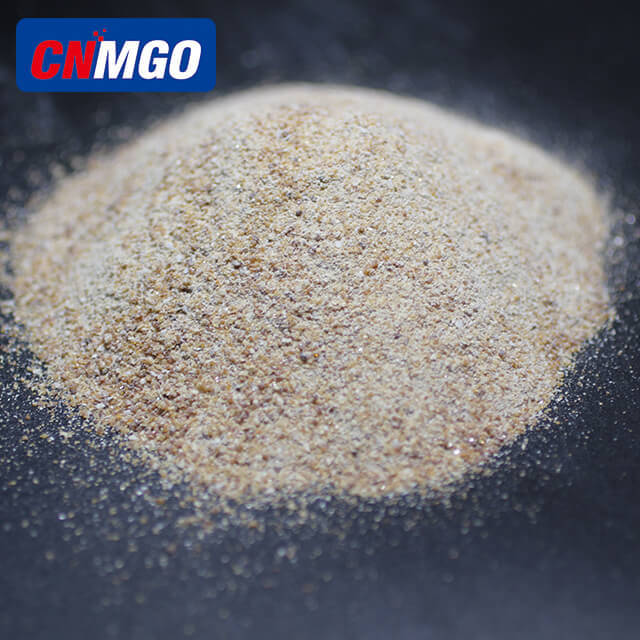
DBM granular, 0 to 4 mm, the reference grade most refractory buyers track for price.
Demand Signals From Steel and Agriculture
On the demand side, two indicators are worth following. Steel production, particularly in India, the Middle East and Southeast Asia, drives refractory grade consumption and therefore DBM and fused magnesia pricing; watch crude steel output and capacity announcements rather than general economic headlines. Agriculture drives magnesium sulphate and agricultural light burned magnesia, and there the leading indicators are planted area, fertiliser affordability and the crop prices of oil palm and rubber. Environmental demand for CCM in flue gas desulfurization and wastewater treatment is policy-driven and tends to be the most stable of the three.
Three practical steps follow from all of this. First, contract on a schedule rather than spot: a rolling quarterly or half-yearly agreement with a defined price adjustment mechanism gives both sides predictability. Second, separate the price conversation from the specification conversation; a tight specification with documented lot data is worth more than a slightly cheaper tonne that cannot be traced. Third, hold a modest safety stock of the grades that are energy-intensive or lead-time-sensitive, and time purchases ahead of the known seasonal pressure points rather than after them.

HOLY Perspective
HOLY (CNMGO Group Limited) produces CCM, DBM, fused magnesia and magnesium sulphate at Dashiqiao in Liaoning and quotes FOB Dalian for more than 50 destination markets. Share your 2027 volume by grade and we will discuss a supply arrangement that manages price risk on both sides.